European supply chain and alternative component management
Reliable UAS production depends on components that can be obtained on time, identified precisely and integrated consistently. A European supplier network can support purchasing, replenishment and technical cooperation. Supply continuity, however, requires more than a long supplier list: approved components, a controlled bill of materials and a defined process for assessing alternatives must work together.
- A supplier network should support both production and service needs.
- A different supplier and a different component are separate decisions.
- An alternative becomes approved for a configuration through documented verification.
- A controlled BOM connects procurement, engineering and the actual unit built.
Start a European supplier network with defined needs
Supply planning should separate production demand, service inventory and components required for evaluation. Their timing differs. Production needs predictable replenishment; service needs the ability to restore a particular product; engineering needs samples and accurate documentation. A single shopping list does not capture those different priorities.
European distributors, specialist component suppliers and manufacturing partners can be evaluated through stock location, communication, purchasing terms, technical records and return arrangements. A supplier’s location describes a supply channel; it does not establish the manufacturing location of every component sold. Here, a European network means purchasing, logistics and support relationships.
A shorter logistics route may be useful, but delivery dates need confirmation for the specific order. Availability displayed on a product page does not necessarily mean that a quantity has been reserved. A workable plan needs agreed quantities, dates, supply updates and responsibility for communicating changes. Forecast demand should be distinguished from a confirmed purchase commitment.
More suppliers do not always create independent supply
The same component may be available through several channels. This can simplify purchasing or reduce reliance on one warehouse, while all channels may still depend on the same manufacturer. Supply risk assessment should therefore record the component manufacturer, the manufacturer’s part number and the commercial supplier separately.
If a primary part becomes unavailable, there are two distinct options: find another supplier for the same part, or assess a different part. The first requires exact identification, revision checks and purchasing records. The second requires an engineering decision. A similar description or appearance is insufficient evidence of compatibility.
Inventory reserves should reflect consumption, replenishment time and component criticality. Excess stock also has a cost: it ties up capital and can become unsuitable after a platform change. Review the supply plan together with production forecasts and approved configurations. Keeping one outdated component in large quantities is not equivalent to maintaining a usable service reserve.
Approve an alternative within the system
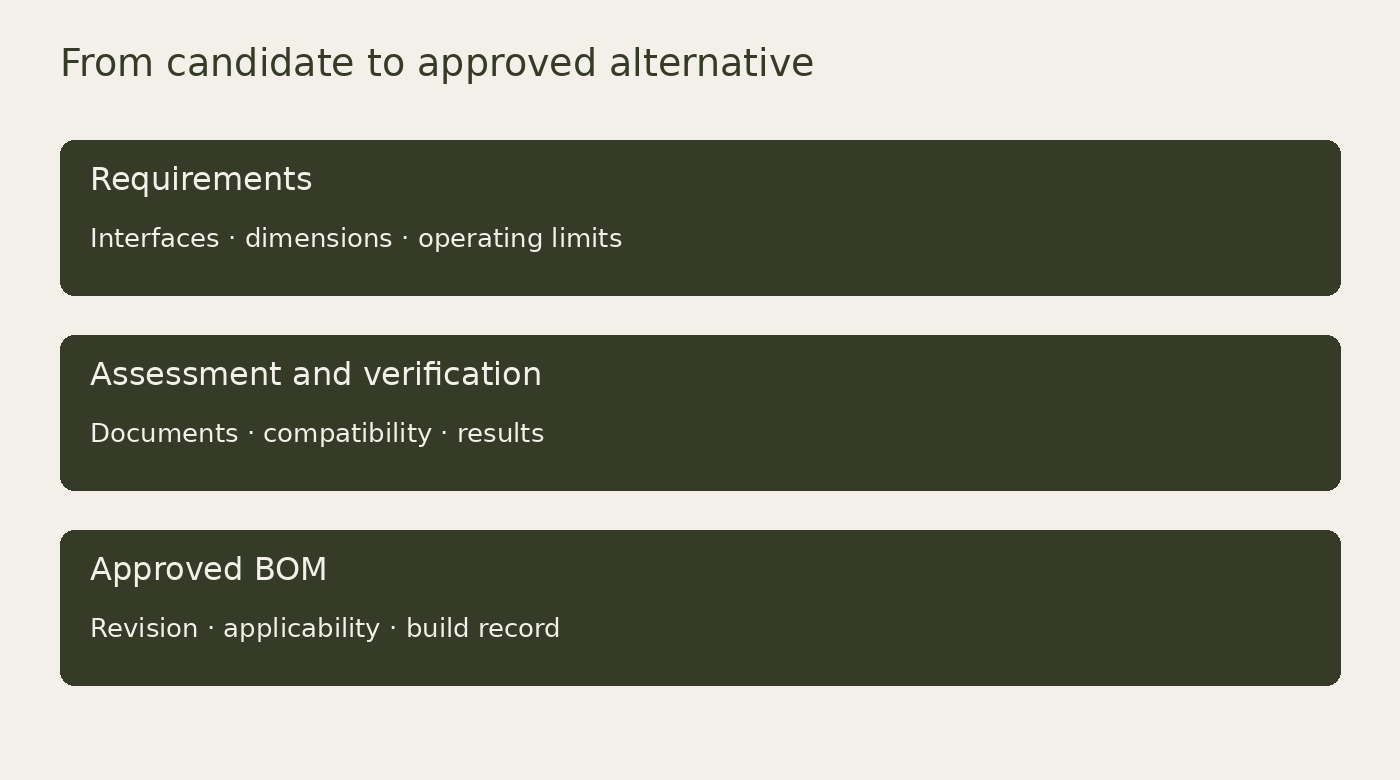
Alternative selection starts with the requirements for the specific component. Assess dimensions, mounting, connectors, power, interfaces and operating limits. Electronics also require consideration of software support, configuration and verification access. Missing documentation is an unresolved evaluation issue rather than an invitation to assume equivalence.
Verification scope should follow the consequences of the change. Replacing a fastener and replacing a flight controller require different assessments. Every approved alternative nevertheless needs a defined application: the platforms and revisions in which it is permitted, any restrictions and the responsible approval authority.
Commercial availability is only one input to this decision. The engineering team must also establish whether assembly instructions, inspection methods, software settings or service procedures need revision. Purchasing should receive the released decision, so an attractive quotation does not become an unrecorded production substitution.
Engineering note. An approved alternative is a defined decision for a specific configuration, supported by documentation and verification evidence. It does not authorise unrestricted substitution of similar parts. Required cable, settings or instruction changes belong within the same change scope.
NASA’s configuration management guidance describes proposing, justifying, assessing and approving changes, followed by verification of implementation. These principles provide a useful methodological reference for managing component alternatives. They are presented as an example of disciplined practice, rather than a mandatory UAS manufacturing procedure.
A controlled BOM connects purchasing and engineering
A bill of materials, or BOM, defines the parts and quantities needed for a product. A controlled BOM also has a defined revision, approval status and change process. It separates a configuration released for production from proposed options or an experimental assembly. People using the document should be able to identify its status without relying on informal explanations.
| Record | Practical purpose |
|---|---|
| Internal part code and quantity | Connect the component to the product structure |
| Manufacturer and manufacturer P/N | Define the part being ordered precisely |
| Revision and specification reference | Control the technical version |
| Approved suppliers | Identify purchasing channels |
| Approved alternatives | Define permitted substitutions and limits |
| Verification and decision record | Support the approval of an alternative |
| Configuration applicability | Connect the change to specific platforms |
In a hypothetical training-platform BOM, the primary controller might have one approved alternative. If using that alternative requires another cable and a different settings package, those elements are released together. The build record identifies which variant was installed in each unit. Service personnel can subsequently select the correct replacement using the recorded equipment state.
Monitor changes before inventory becomes a problem
A component’s lifecycle extends beyond the current warehouse balance. A change to its design, manufacturing process or specification may require a suitability review. Assign responsibility for receiving supplier or manufacturer notices, connecting them to BOM records and initiating technical assessment.
As a concrete electronics-sector example, Texas Instruments’ product change notification description includes the reason for a change, affected products, anticipated impact and qualification information. This illustrates the value of documented change communication. It makes no claim about the components or suppliers used by FPV DRONAS.
An organisation should define how different stock revisions are handled and when an approved change becomes effective. Before making a larger purchase, assess whether remaining parts will support future production and existing platforms. A rushed purchase without this review can move an unresolved engineering issue into the warehouse. Notifications, inventory and configuration decisions should be reviewed together.
Traceable records support continuity of service
Incoming inspection should compare the ordered part, quantity, revision, packaging and records. Where batch identification matters to the product, connect it to the manufacturing record. Uncertain or nonconforming components need a separate status so their physical presence in stock does not make them available for assembly automatically.
A European supplier network becomes useful when procurement, engineering and service work from consistent current information. The objective is a clear path from a requirement to an approved component and the history of a particular product. That process supports replenishment planning, controlled alternatives and consistent documentation. It also makes conversations with suppliers more precise because a request refers to an identifiable part and released configuration.
FPV DRONAS aims to establish its own line of electronic components to support more consistent assembly planning, smoother logistics and greater continuity of component supply. This development direction is linked to clearer control of component versions, compatibility and long-term platform support. It is a company ambition whose implementation requires engineering, verification and supply planning.
Discuss technical package requirements with FPV DRONAS: specify planned quantities, delivery dates, the support period and the required scope of documentation.