What Professional FPV Operators Actually Need: Building UAS Around the User
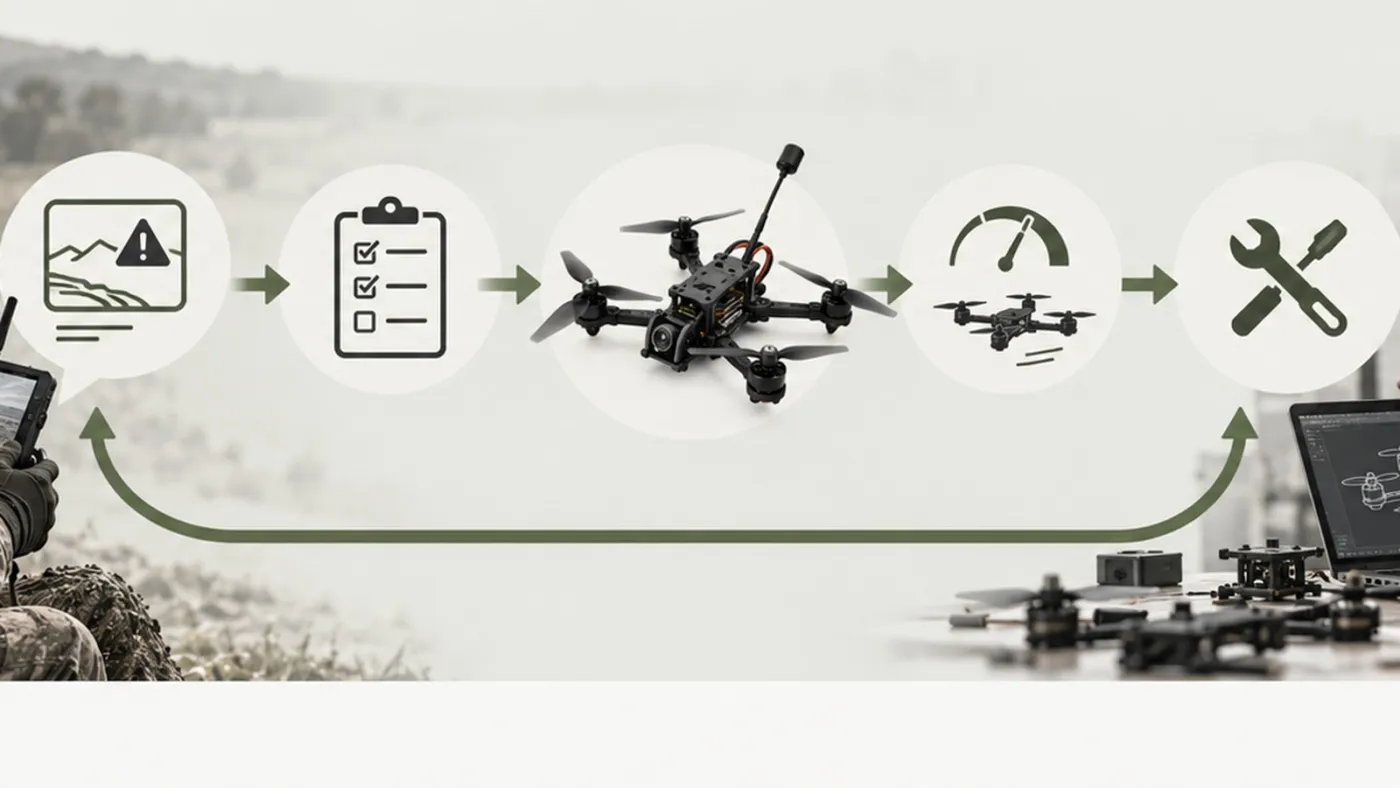
A professional FPV drone should not start with a component list. It should start with an operator problem: what the user must achieve, under what conditions, how quickly the system has to be prepared, and what can realistically be repaired when the aircraft is in service.
Key idea
- A useful professional UAS begins with a clearly defined operational need, not with a collection of “best” components.
- Operator feedback must be converted into an engineering requirement instead of remaining an informal comment.
- The platform should be designed to evolve, be repaired and be documented without rebuilding the entire aircraft every time requirements change.
A specification is not the same as a requirement
A common mistake in small UAS development is to begin with numbers: frame size, motor KV, battery capacity, video system or advertised range. These parameters matter, but they are part of the solution, not the original requirement.
An operator requirement usually sounds different: the system must be ready within minutes; a damaged part should be replaceable in field conditions; the same operator should be able to move to another configuration without an entirely new training cycle; or the transport kit should not become a larger burden than the aircraft itself.
The engineering task is to translate statements like these into measurable criteria. Only then is it possible to make defensible decisions about the airframe, electronics, energy source, connectors, fasteners, software configuration and spare-parts package.
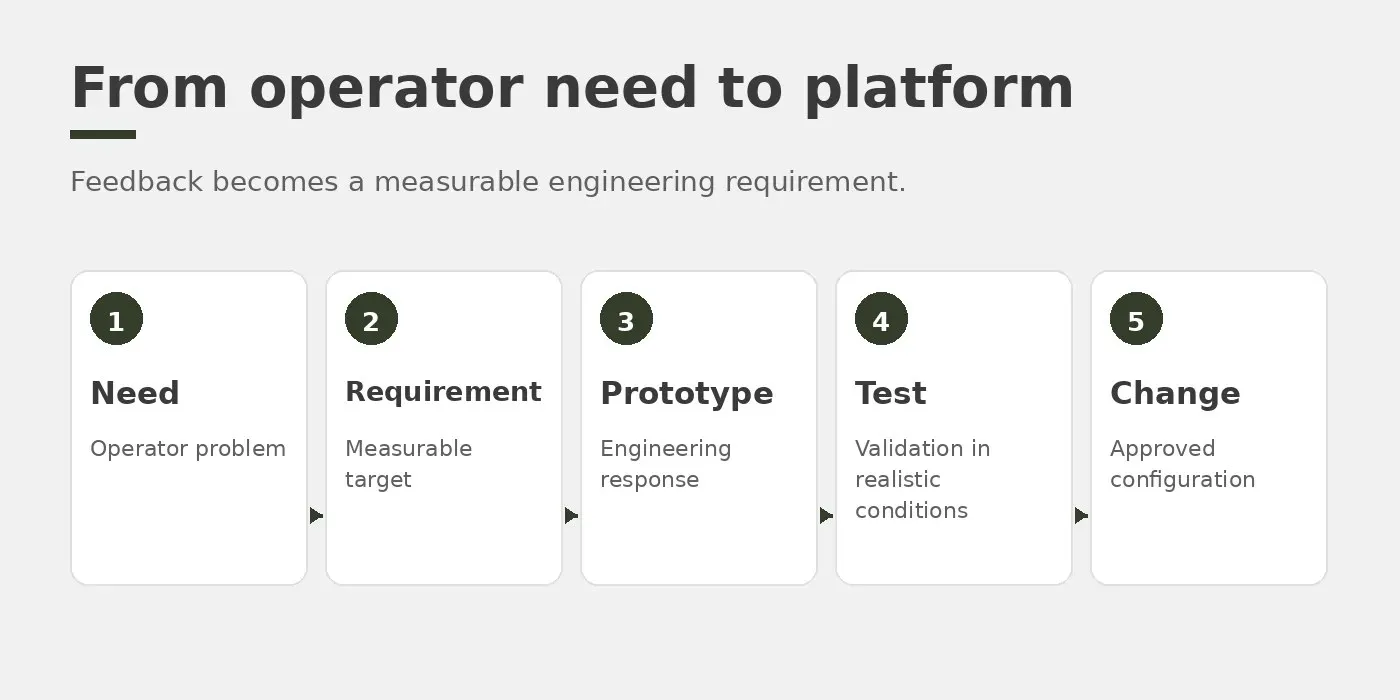
Engineering note. The operator is best placed to describe the problem. The engineer’s job is not to ask the operator to design the solution, but to derive technical requirements from operational experience and verify them.
What actually matters to the operator?
Different missions create different priorities, but several themes repeatedly appear in small UAS: simplicity of preparation, reliability, maintainability, a clear user interface, manageable logistics and the ability to adapt quickly when conditions change.
| Operator question | Engineering translation |
|---|---|
| Can I get the system ready quickly? | Assembly, power-up and pre-flight time; number of steps; error-proofing. |
| Can I repair it in the field? | Modular construction, standardised fasteners and connectors, accessible replaceable parts. |
| Will it behave the same after a component change? | Configuration control, firmware versions, approved substitutions and a defined test procedure. |
| Can training transfer to another platform in the same family? | Common control logic, consistent procedures and maximum practical component commonality. |
| Can we sustain the system after delivery? | Spare-parts structure, repair documentation, serialisation, technical support and supply planning. |
Real case: Ukraine’s Brave1 and operator-driven FPV development
In August 2026, Ukraine’s defence innovation cluster Brave1 held an FPV technology demonstration event involving more than 400 participants and over 50 manufacturers presenting solutions intended to improve existing FPV systems. The purpose was not merely to showcase products. It was explicitly structured to expose military users to new technologies, collect feedback and help manufacturers create solutions around real frontline requirements.
One particularly relevant example was the presentation of three modular FPV platforms designed so that frequencies or individual components could be changed without rebuilding the entire drone. Brave1 emphasised that this type of adaptability should be integrated at the production stage, rather than shifting the modification burden to military workshops.
The same logic extends beyond a single event. In 2026, Brave1 reported that it had awarded more than 1,000 defence-innovation grants and described a development model in which a company receives support, tests a product together with the military, receives feedback and only then moves towards scaled production.
This is not unique to Ukraine. The U.S. Army used a similar approach in its Short Range Reconnaissance programme, applying iterative development in which Soldier testing and immediate feedback were provided directly to commercial developers during the development phase. Later user evaluations looked not only at the aircraft but also at software, user interfaces and realistic operational scenarios.
Why this matters now
The technology cycle for FPV and other small UAS is unusually short. Electronic-warfare conditions, communications architectures, component availability and operator methods can change faster than a traditional multi-year development programme. NATO training material on lessons from Russia’s war against Ukraine highlights the need for militaries to be able to rapidly field, test, exploit and adapt relatively low-cost UAS.
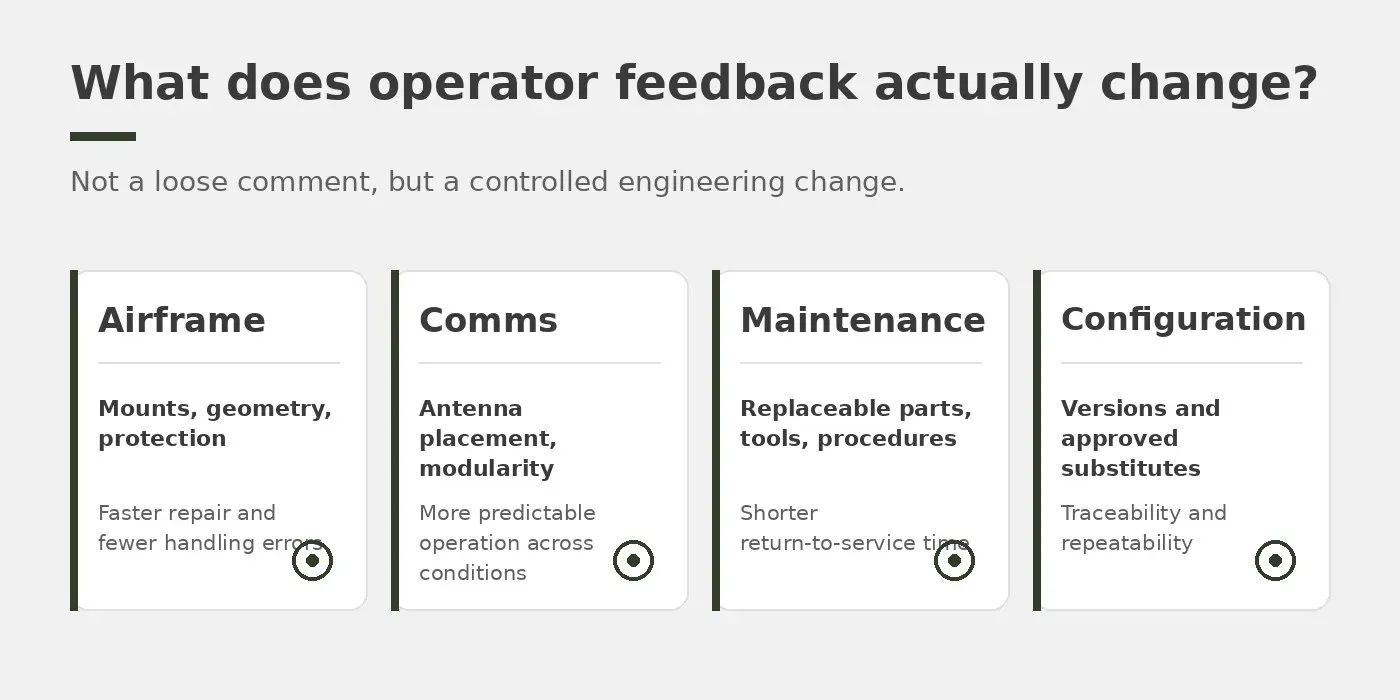
For that reason, a “finished product” in the defence UAS domain should not mean an unchangeable design. A better model is a controlled platform: a defined baseline configuration, approved variants, traceable versions and a process through which an operator requirement can become a documented engineering change.
From a comment to a controlled change
Feedback alone is not product development. It needs a process. A practical model can be straightforward:
- Requirement. The operator or organisation describes the problem, condition or requested capability.
- Engineering review. The team defines what must change and how success will be evaluated.
- Prototype. A controlled test configuration is produced.
- Validation. The solution is tested technically and, where possible, with representative users.
- Configuration release. An approved change receives a defined version, documentation and compatible-parts list.
- Feedback loop. In-service information feeds the next development cycle.
How we are applying this at FPV DRONAS
The same principle is being applied to three new FPV DRONAS platforms currently in development. The objective is not to create three unrelated “best drones”. It is to create a coherent platform family in which each system has a defined role, while common engineering choices, documentation, spare parts and training remain aligned wherever practical.
In parallel, we are building a channel through which armed forces, units, instructors and other professional users can submit a requirement, observed problem or proposed modification. A public portal is not intended for sensitive operational information; such information should only be shared through appropriate, agreed channels.
A good military drone is not simply one that flies well
It must be understandable to the operator, maintainable by the technician, manageable for logistics and flexible enough for engineering. When these four perspectives are incorporated before the design is frozen, the result is not merely a demonstrator but a system that can be operated, supported and improved over time.
Have a technical requirement, observation or proposed platform change? Submit it through the FPV DRONAS requirements and technical-support channel. The more clearly the problem and operating context are defined, the more effectively they can be converted into a verifiable engineering requirement.